FGLEA Lagos Strategic Command managed officer attendance, deployment records, and nominal roll documentation through a manual, paper-based process — difficult to retrieve, prone to error, and impossible to audit in real time. As sole developer and IT analyst, I built and deployed a custom web application tailored to the command's operational structure, replacing the paper process entirely and onboarding 485 officers onto a live, auditable digital system.
- 485 officers successfully onboarded; the manual paper-based nominal roll process is fully eliminated at the strategic command level
- Role-based access control preserved unit-level accountability that the paper process couldn't reliably enforce
- System adoption depended on trust-building through informal orientation sessions, not just technical delivery
- Design accounted for inconsistent field connectivity — lightweight page loads, minimal real-time dependency for core functions
The Problem
Officer attendance, deployment, and nominal roll documentation lived entirely in physical registers — vulnerable to loss, damage, and manipulation, with no centralised way to track officer data or generate reports in real time. For a law enforcement agency operating at strategic command level, this wasn't just an administrative inconvenience; it was a governance and accountability risk.
The Approach
Rather than recommending an off-the-shelf solution requiring extensive procurement and licensing overhead, I proposed and built a custom web application tailored specifically to the command's operational structure. The design process began with direct engagement with operational staff — mapping existing record-keeping workflows, understanding which data points mattered for command oversight, and identifying where the paper process failed most often.
Key design decisions:
- Web-based architecture for cross-device access without software installation
- Role-based data entry to maintain accountability at the unit level
- Simple, low-friction UI to support adoption by non-technical staff
- Offline-resilient design considerations given field-network variability
Architecture & Technical Implementation
- Frontend — responsive web interface with clean, form-based data entry flows
- Backend — server-side logic handling officer records, unit assignments, and deployment data
- Database — structured relational schema supporting officer profiles, rank data, unit hierarchy, and roll history
- Access control — role-differentiated permissions across data entry operators, supervisors, and command-level administrators
- Reporting — on-demand nominal roll generation and export, replacing manual compilation entirely
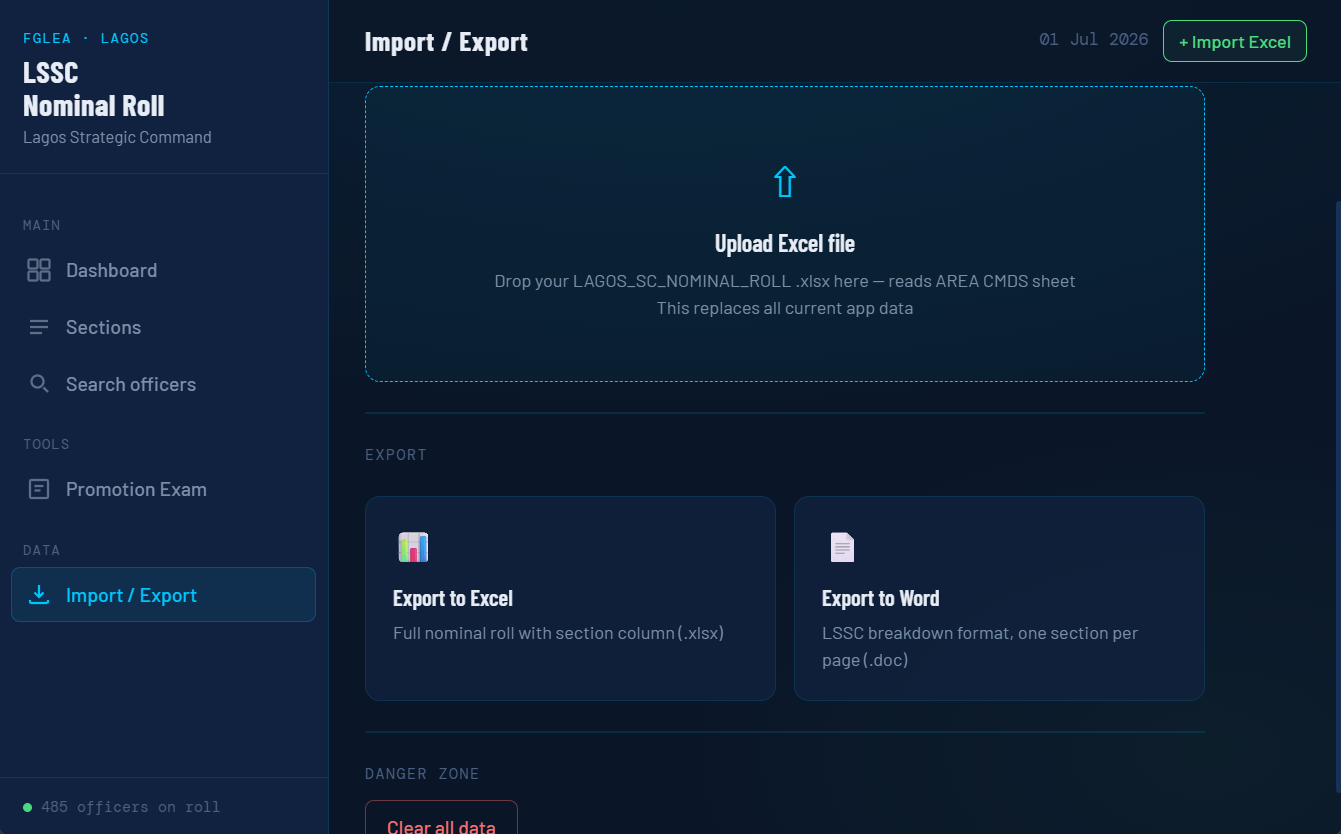
Import/Export dashboard — live system, 485 officers on roll as of Jul 2026
This project later added a Promotion Exam Eligibility Matcher module, cross-referencing officer records against eligibility criteria for promotion exams — extending the system from records management into decision support.
Challenges
Adoption resistance. Introducing a digital system into an environment with established manual workflows required trust-building, not just technical delivery. I ran informal orientation sessions with key personnel to demonstrate reliability before full rollout.
Data migration. Existing officer records existed only on paper. I coordinated a structured digitisation phase, verifying accuracy against source documents so the system launched with clean, reliable data.
Connectivity variability. Not all units had consistent internet access. The system prioritised lightweight page loads and minimised real-time connectivity dependency for core functions.
Results
- 485 FGLEA officers successfully onboarded onto the platform
- Manual paper-based nominal roll process fully eliminated at the strategic command level
- Operational reporting time reduced significantly — manual cross-unit compilation now generates on demand
- Improved accountability and auditability of officer records at the command level
- System remains actively in use, demonstrating sustained operational value beyond initial deployment
Lessons Learned
Technical correctness is the baseline, not the goal. The system only delivered value because it was actually adopted — and adoption required understanding the human and organisational context as much as the technical requirements. I would now build in a more formal feedback loop from the start, collecting structured user input during early rollout rather than relying on informal observation.
What I'd Improve
- Implement automated backup and data export scheduling from day one
- Add audit logging for all record modifications to strengthen the accountability trail
- Build a command-level dashboard with visual reporting (deployment coverage, unit counts, rank distribution)
- Explore progressive web app (PWA) capabilities to improve offline resilience
References
- Full repository — github.com/Cyber-Nate/Automated-Nominal-Roll-Webapp